
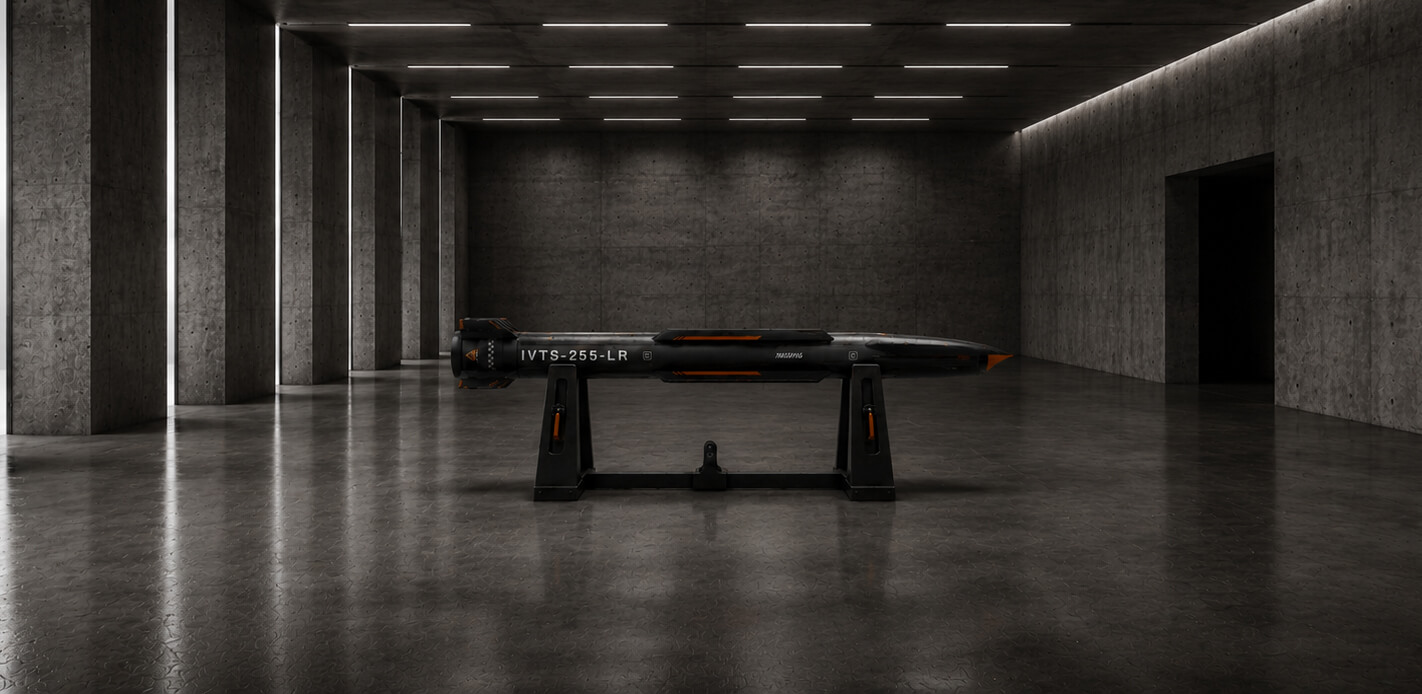
NEWPORT BEACH, California, 20 August 2026 – Tiberius Aerospace, the modern defense technology company building next-generation weapon systems and AI-powered defense solutions for the United States, United Kingdom and allied nations, today announced that Invictus is moving from laboratory investigation into formal engineering and Test & Evaluation (T&E) development, marking a major step towards fielding its next-generation long-range precision strike system.
The transition moves Invictus beyond exploratory laboratory development and into a structured engineering program focused on validating propulsion, flight performance, guidance, platform integration and manufacturability through formal testing. Direct-connect testing of the Invictus ramjet engine is already underway at Purdue’s Zucrow Laboratories, where the engine has demonstrated excellent operability using Jet-A across all conditions tested to date.
Invictus is a tube-launched, multi-mission system designed for integration across multiple platforms and domains. Its architecture is intended to support launch from vertical launch systems and autonomous vehicles operating across land and sea, giving warfighters greater flexibility in how long-range precision effects are delivered.
The program is advancing against an increasingly urgent strategic challenge: the need for the United States and its allies to rebuild long-range precision strike capacity faster than traditional defense production can replenish it. The U.S. Army used virtually all of its stockpile of ATACMS and Precision Strike Missiles during the five-month conflict with Iran, intensifying concerns about readiness for future contingencies. Across Europe, Western missile inventories have also come under growing pressure, driving NATO governments and manufacturers to accelerate production and rebuild stockpiles.
Invictus is being designed to address both capability and capacity, combining long-range precision with an architecture built for adaptability and scale. The Invictus-200 will pair a ramjet with an integral booster to deliver speeds up to Mach 3 and precision strike at ranges of up to 200 kilometers, with targeting precision of 5.5-meter CEP depending on guidance configuration. Its 10–15 kilogram payload capacity and modular, open architecture will allow the system to be configured for different missions and evolve as operational requirements change.
“The move into formal engineering, testing and evaluation is a major step toward turning Invictus from a promising technology into a deployable capability,” said Chad Steelberg, Founder and CEO of Tiberius Aerospace. “We are designing Invictus around cost-effective lethality from the outset, maximizing the combat effect delivered for every dollar spent by simplifying the weapon, engineering it for high-volume production and building in an open architecture that can evolve without replacing the entire system. That matters because the challenge for the United States and NATO is not simply building another exquisite long-range weapon; it is fielding enough lethal capability, at a cost we can sustain. Invictus is being built as a multi-mission, tube-launched system capable of delivering multi-domain precision effects. Range matters and lethality matters but if you cannot afford to field it at scale, it does not solve the problem.”
At the heart of Invictus’ development is GRAIL, Tiberius Aerospace’s AI-powered platform for developing, evaluating and scaling next-generation weapon systems. Tiberius Aerospace used GRAIL Effects to model Invictus against specific targets and realistic operating conditions, assessing mission effectiveness alongside cost, readiness, sustainment and supply-chain constraints. This analysis will optimize Invictus for cost-effective lethality, delivering a 10x cost-lethality score by maximizing the operational effect delivered for the resources required to produce and field the system. GRAIL Effects also applies TELS, the Target Effective Lethality Score, to assess how effectively a weapon neutralizes a specific target, helping identify overmatch, underperformance and mission fit so the right effect can be matched to the right target.
The same GRAIL approach informs Invictus’ manufacturing model. Through GRAIL Agility, Tiberius Aerospace can connect program requirements with domestic and allied suppliers capable of producing components and systems, supporting a broader and more resilient industrial base. Invictus is being engineered with a simplified architecture and fewer parts to support cost-effective, high-volume production rather than reliance on a narrow, highly concentrated supply chain. Its modular architecture is also designed to allow guidance, payload and mission capabilities to be upgraded over time without requiring the entire weapon system to be redesigned, extending Invictus’ relevance as threats and technologies change.
Invictus will bring together long-range precision, multi-domain flexibility, cost-effective lethality and scalable production in a weapon designed not only for today’s operational requirements, but for continuous adaptation throughout its service life.
About Tiberius Aerospace
Tiberius Aerospace is a modern defense technology company building next-generation weapon systems and AI-powered defense solutions for the United States, United Kingdom and allied nations. Its technologies include Sceptre, its next-generation precision-guided ramjet-powered 155mm artillery munition; Invictus, its scalable long-range precision missile platform; and GRAIL, its AI-powered platform for the continuous iteration of weapon systems.
For more information, visit www.tiberius.com.